.

.
Showing posts with label Gay Nineties. Show all posts

Wednesday, 6 May 2020

Clement Fezandié's Through the Earth, Parts III and IV

The bold experiment of drilling a tunnel through the earth complete, parts III and IV of Clement Fezandié's Through the Earth follow young William Swindon's experiences as he makes the perilous first voyage. In a footnote, the author assures us that his text has been double-checked for accuracy by a professor of Applied Mechanics, and what he describes is a fairly accurate impression of artificial weightlessness created through extended freefall. It's much the same process used by NASA to train astronauts, though in the real-world case it is induced by plummeting a special airplane into freefall. It is also how space shuttles and other bodies achieve orbit. Technically they are constantly falling towards the earth, but the earth curves away beneath them before they can land. 

These chapters appear as they originally did in the March and April 1898 editions of St. Nicholas Magazine, with illustrations of William A. Mackay. After the serial completed, Fezandié and St. Nicholas Magazine's parent company, The Century Co., republished it as a book with some additional chapters of background and incident. 


Wednesday, 29 April 2020

Clement Fezandié's Through the Earth, Parts I and II

What would be the most efficient way to pass from one side of the earth to the other? That's the old trick of the two dimensional map: you'd think it would be a straight line, but on a globe that translates into the curved line of airline flight paths. In the 19th century, there was no expedient way to circumnavigate the globe. Jules Verne showed that it could theoretically be done in 80 days, but the average traveler would be spending many more months at it. 

But what if you could just go through the earth?  

That is the question being broached by Clement Fezandié in this four-part serial that was published in the January-April 1898 volumes of St. Nicholas Magazine. The first two parts, presented here as they originally appeared, with illustrations by William A. Mackay (more famous for his role in developing ship camouflage for the US Navy), focus on the theory and construction of a tube from New York to Australia through the earth's core, and how people and freight may be moved along such a hazardous route.

Click on each page to see a larger version, and join us again next week for parts III and IV! 


Wednesday, 15 April 2020

Cinématographe Lumière


The following string of films reconstructs the first ever public film screening, presented by the Lumière Brothers at the Salon Indien du Grand Café in Paris, France. The very first performance was a private affair on December 28th, 1895, with public performances following a few months later.

Auguste and Louis Lumière were acquainted with photography from a young age, being the children of an accomplished photographer in his own right. After their father passed away in 1892, the brothers were free to explore emerging technologies like those pioneered by animator Émile Reynaud. In 1895 they patented the cinématographe and ushered in the age of modern film.

The playlist for their quite profitable public performances featured, in order: La Sortie de l'Usine Lumière à Lyon ("Workers Leaving the Lumiere Factory", also the first film they made), La Voltige ("Horse Trick Riders"), La Pêche aux poissons rouges ("fishing for goldfish"), Le Débarquement du Congrès de Photographie à Lyon ("the disembarkment of the Congress of Photographers in Lyon"), Les Forgerons ("Blacksmiths"), Le Jardinier (l'Arroseur Arrosé) ("The Gardener," or "The Sprinkler Sprinkled"), Repas de bébé ("Baby's Breakfast"), Le Saut à la couverture ("Jumping Onto the Blanket"), La Place des Cordeliers à Lyon ("Cordeliers Square in Lyon"--a street scene), La Mer (Baignade en mer) ("the sea [bathing in the sea]").

I apologize for not being able to provide the rich surroundings of a fin de siècle salon in which to enjoy the following shorts, but a weblog can only do so much...


Wednesday, 7 August 2019

Deutschland im Jahre 2000

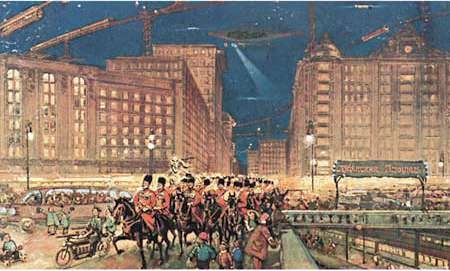
In January 1900, the German chocolate company Hildebrands placed these depictions of the Fatherland in the year 2000 in packages of cocoa and chocolates. Like En L'An 2000 and Moscow in the XXIII Century, these cards depict the usual turn of the century ambitions: airships, submarines, covered cities, television, and improved security. The overriding theme is bringing the hitherto unobtainable into the everyday. Aerial travel becomes everyday, and can even be used to venture to impenetrable locales like the Arctic. The oceans become accessible, and what isn't directly accessible is observable through mass media. So, in many ways, we are living in the golden age of Victorian futurism... I just wish it looked as good as these cards.   


Wednesday, 29 May 2019

Chocolat Lombart en l'an 2012

Founded in 1760, Chocolat Lombart was, in its heyday, the oldest and largest company in France. By the 1889 Exposition Universelle, the company was considered a model of efficiency and employee welfare. Their modern factory employed 500 people and provided health insurance, housing, and offered workers a share in the annual profits. All this had to be paid for by chocolate. Like cigarettes, fanciful collectors cards were included in chocolate packages to bolster those sales. In 1912, Chocolat Lombard presented its vision of all the amazing ways that customers could buy Lombart chocolates a century in the future.  

Don't forget the Lombart chocolates!

Stopping off at the chocolaterie.

On the video-phone with their son in Asia.

Chocolate delivery by air.

Le voyages dans la Lune.

Unda' the sea.

Unfortunately, if this advertising worked and you want to enjoy Chocolat Lombart yourself, you're out of luck. The company was absorbed by Menier Chocolates in 1957.  

Wednesday, 14 November 2018

Red Dead Redemption's Weird Western World

The original Red Dead Redemption, released in 2010 by Rockstar Games for Xbox 360 and PlayStation 3, is considered by many to be a high-water mark in video gaming. Following the "open world" format of Rockstar's infamous Grand Theft Auto series, the mean streets of major modern metropoli were replaced with the Wild West of Italian cinema. Furthermore, the chain of events was given the compelling story of John Marston, a former outlaw who is forced to hunt down his old gang members across Mexico and the fictional State of New Austin after the government takes his family hostage. The game became a perfect example of the growing propensity for video games to transcend film as the art form of the 21st century. Beautifully rendered environments coupled with engaging storytelling and characters that literally involve the player for hours upon hours of entertainment. 

Red Dead Redemption release trailer.


Advances in technology have meant that no video game is truly complete. Indeed, the "day one update" phenomena has shown that most games aren't even fully debugged and ready to run when they are sold. But where there is extra money to make, downloadable content (DLC) is soon to follow. Picking up before Red Dead Redemption's epilogue, the Undead Nightmare DLC (2010) throws a supernatural curve into Marston's settled life. Just when he thought his family was safe, both his wife and son succumb to a zombie plague breaking out across the frontier. Naturally, it is up to the former outlaw to solve a mystery going back to ancient Aztec worship of the Sun. 

Along the way, Marston encounters even more strangeness. As the world is ripped asunder by a zombie apocalypse, the Four Horsemen's steeds roam the Earth. Marston has the option of taming War, Famine, Pestilence and Death, each with their own unique effects on the brain-eating hordes. Somewhere out there in the wilds is also a unicorn that trails a rainbow behind it as you ride. Joining him are jackalope and chupacabra, and a pathos-inspiring episode with Sasquatch. A new mythology for the zombies does not exactly utilize the creature's largely forgotten origins in Voodoo shamanism, but does draw the modern metaphor of cosmic nihilism and urban distress further back in that direction.  

Undead Nightmare trailer.


Undead Nightmare was criticized from some quarters upon its release, as a number of fans of the original game felt that it undermined Red Dead Redemption's realism to jump on the zombie bandwagon. On the one hand, this realism is overstated: the West was not nearly as wild and bloodthirsty as cinema has made it out to be. Red Dead is an interactive Western movie, pulling tropes and archetypes from Hollywood's gunslingers. A truly realistic Western game would involve an unrelenting tedium of plowing land, driving cattle, and months-long bounty hunts. Violent and gritty does not equate to realistic, and it's surprising to learn that anyone has thought that way since the 1990's. Rockstar already sacrificed realism for an entertaining product.

Apparently those critics were a minor voice, because the more recently released prequel Red Dead Redemption II (2018) for Xbox One and Playstation 4 goes much further in integrating elements of the Weird Western into their otherwise more realistic game. In this installment set in 1899, 13 years before Red Dead Redemption, you play Arthur Morgan, the enforcer of John Martson's old gang. After a robbery gone wrong, the gang is on the lam and trekking across the American landscape to avoid Pinkertons and bounty hunters. We see the gang both at the height of its power and through its fall into madness, despair, and death. 

Red Dead Redemption II release trailer.


The game pushes beyond the tropes of the Spaghetti Western to be a much more realistic take on true Western life. Opportunities for fastpaced, bloodthirsty gunplay are further between and resource management becomes a much more significant part of the game. You have to watch out for the well-being of the camp, your horse, and your character, meaning there is more hunting, crafting, bathing, feeding, and brushing going on. The world of Red Dead Redemption II is much more fully and beautifully realized as well. Its sprawling map is a microcosom of the United States, with regions identifiable to actual parts of the country. The city of Saint Denis is a stand-in for New Orleans, surrounded by bayous and neighbouring the red earth of the post-Civil War American South. North is "Roanoke", replicating the Appalachians and Hudson Valley. To the West are ranges of mountains reflecting the Sierra Nevadas and Canadian Rocky Mountains. Tucked in the midst of the mountains is a small tribute to the geyser basins of Yellowstone. In the middle of the map is the eerily accurate "Heartlands" that look exactly like what one would see driving through the grasslands and badlands of the prairies. New Austin returns as the equivalent of Texas.

Throughout this immense world are a plethora of sights and strangers that get weirder and weirder as the game progresses. The original game had its share of odd characters, eccentrics mostly. The only clearly supernatural figure in Red Dead Redemption was the mysterious Stranger, an unkillable, top-hatted gentleman who appears to know everything about John Marston's past... and future. It was a statement by him that provided the seed for Red Dead Redemption II's precipitating incident. Yet he is poorly defined and there is much speculation as to whether he is God, or Satan, or something else entirely. Much like the stranger in the Clint Eastwood film High Plains Drifter (1973), there are hints as to who this Stranger could be, but overall he is an encounter with the Unknown beyond human ken.

Compilation of scenes with the Stranger.


By contrast,  Red Dead Redemption II goes balls to the wall nuts at times. Extraterrestrial visitors appear at least three times in the sky, first above the ruined shack of a Heaven's Gate-style suicide cult. A ghost in the swamps outside Saint Denis eternally relives her tragic tale of lost love and suicide. Speaking of Saint Denis, what would a proxy of New Orleans be without a vampire? Sasquatch bones can be sighted in a mountain cave, a horrific Moreauesque experiment can be found in a deserted house, high in the hills is a witch's hovel with a cauldron brewing, and human sacrifices by pagan cults dot the landscape, as do ancient fossils, Viking burials, pirate wrecks, and crashed flying machines. A side mission has you searching for mysterious rock carvings of Zeppelins and atomic bomb explosions for a man who looks and talks like he is from the 1920's. Another mission has you performing tasks for a Tesla-like genius, culminating in the discovery of an automaton that looks like a cross between Boilerplate and Bender. 

The following videos by LegacyKillaHD showcase some the various Easter eggs and where to find them, though (more) spoilers ahead for those waiting to find them for themselves...


Wednesday, 4 April 2018

Capt. H.G. Bishop's Congealing the Ice Trust

The romance of the Gay Nineties has its automatic signifiers. Ladies with bustles and feathered hats, men in dapper suits and handlebar moustaches, barbershop quartets, penny-farthing bicycles, horse-drawn carriages, gingerbread architecture, gaslight, and other such "Main Street USA" accoutrements immediately identify a setting in the last decades of the 19th century and first decades of the 20th. Another ubiquitous image is the iceman, hocking blocks of ice from the back of his wagon, destined for the iceboxes of home and restaurant.

The ice man visits Washington D.C.'s first public school for
African American children, c. 1899. Photo: Library of Congress.

Iceboxes were, for all intents and purposes, like modern refrigerators without the machinery. In place of the freezer unit at the top of refrigerator would be a box for holding a block of ice. Those blocks of ice were harvested from lakes and ponds and stored in insulated ice houses through the year. The iceman would then collect blocks of ice into his cart and truck around town. It's all very quaint and nostalgic... But how would this industry be transformed in a world where inventors are regularly firing themselves into outer space, disintegrating and shrinking each other, and voyaging across the planet by airship and submarine?

Captain H.G. Bishop's 1907 short story Congealing the Ice Trust attempts to address this question.


Saturday, 10 March 2018

Alienation, Modernity, and Nostalgia in The Twilight Zone and Somewhere in Time


Today's special post is part of the Time Travel Blogathon hosted by Wide Screen World and Silver Screenings. Click on the banner above to see more excellent time-tossed movie reviews.


A recurring theme in The Twilight Zone is the existential angst of the modern male. Its canon of episodes is replete with middle-age guys who just can't catch a break, who just can't keep up with the pace of life in the jet age. The most famous is Henry Bemis, played by Burgess Meredith in the classic Time Enough at Last (1959), a henpecked bookworm who just wants to curl up with a good story. A well-timed outbreak of nuclear war does a fine job of taking care of distractions, but as you can imagine, there is always a catch in... The Twilight Zone.


Rejection of the modern day for the allure of the past was a recurring exploration of this theme. It was played comically in Once Upon a Time (1961), starring Buster Keaton as a man from the silent film era who trades places with an inventor from the 1960's, both discovering that the grass is not always greener on the other side. A more serious, and heartbreaking, exploration of the idea came with A Stop at Willoughby (1960), penned by Rod Serling himself. It was later adapted as a television film, For All Time (2000) starring Mark Harmon and Mary McDonnell. Richard Matheson, writer of many Twilight Zone episodes including Once Upon a Time and Nightmare at 20,000 Feet (1963), delivered his take on it for a 1975 novel Bid Time Return. That was, in turn, adapted to cinemas as Somewhere in Time (1980) starring Christopher Reeve and Jane Seymour. In both For All Time and Somewhere in Time, the alienated modern man seeks love and fulfillment in the Gay Nineties, with varying degrees of success as lovers and as films.  


Wednesday, 23 August 2017

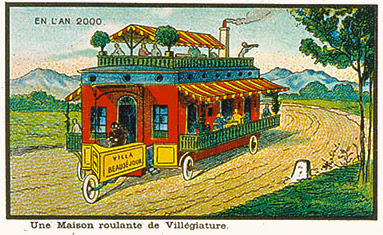
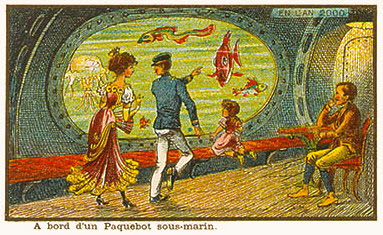
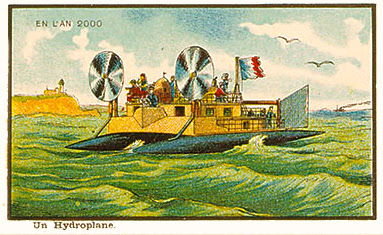
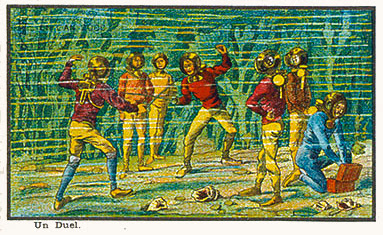
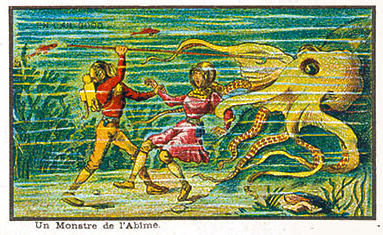
En L'an 2000


En L'An 2000 (English: In the Year 2000) were a series of cigarette cards produced in France at the turn of 1900. The initial series was released between 1899 and 1901, in conjunction with the 1900 Paris Exposition Universelle, when excitement about the advancements of the coming century were accelerating. A second series was produced in 1910.

For the most part, the series is a fanciful impression of retro-futurism. I don't think many of us have fought off octopi in the last 20 years. There were some astute premeditations of modern technologies that we do take for granted, however, and it is interesting to pick out where the people of the fin de siècle actually did get it right. It's just too bad that we couldn't have kept the elegant fashion they predicted as well!

At least 87 cards were known from the series, produced by a variety of different French artists. Just over half are actually preserved and available for online viewing. Those 55 cards are presented here for your own perusal.


Wednesday, 16 November 2016

Walt Disney and the Gay Nineties

In a 1997 exhibition of the same name, scholar Karal Ann Marling aptly described Walt Disney's theme park ventures as "The Architecture of Reassurance." Through gingerbread houses, Western stockades, futuristic rocketships, and fairy tale villages, visitors to the newly christened Disneyland in the Fifties and Sixties could find nostalgia, comfort, and hope for the future through the uncertainties of America's changing culture and global position in the post-war milieu. Complimenting Walt Disney's Disneyland, the theme park, was Walt Disney's Disneyland the television series. Each week, Walt's comforting public persona would introduce updates on the theme park, behind-the-scenes programs for newly arriving films, and reruns of past cinematic successes, each themed to a different section of the park, be it Frontierland, Adventureland, Fantasyland, or Tomorrowland. When first unveiled to the world, "Disneyland" was not merely a theme park or a TV show or motion pictures, but a state of mind. The gateway to this mentality was Main Street U.S.A. and the reassuring myth of the Gay Nineties.