.

.
Showing posts with label Classical Film. Show all posts

Saturday, 7 March 2020

350 Years of the Hudson's Bay Company on Film


Today's special post comes from the 2020 O Canada! Blogathon. Click on the banner above to learn more about films from the Great White North!


One of the oldest American film genres is the Western, dating back to 1903's The Great Train Robbery. Being one of the oldest, it has also been the most prone to falling in and out of favour. Worse yet, it can often become a victim of its own popularity. In the heydays when Westerns were everywhere, filmmakers looked for every opportunity to set the next serial, B-movie, or A-lister apart. That sometimes led to inspired insanity of Weird Westerns like Gene Autry's Phantom Empire, but one of the most enduring has been the "Northern." Still steeped in American attitudes and traditions, the action is transplanted to the mighty "Northwoods." Mounted Police take the place of sheriffs and rangers (despite having very different approaches to law enforcement), French Canadians and Métis take the place of Mexicans and swarthy "half-breeds", the Sierra Nevada mountains replaced Griffith Park (few productions ever actually made it up to the Canadian Rockies), but the movie "Indians" remained more or less the same. And snow. Always snow.

The Klondike Gold Rush of 1896-97 became a potent setting, though it was always imagined by Hollywood's writers and directors to be a wild and lawless place more like Nevada, filled with gunfights and swaggering riverboat gamblers. The reality was that the Mounted Police under the command of Sam Steele kept everything very orderly in the Queen's Dominion, much to the surprise of unruly American Stampeders. Sometimes the setting was the building of the Canadian Pacific Railway across the country in the early 1880's, though again, with considerably more bloodshed than happened in fact. Treaties had been signed between the Crown and Indigenous peoples years before the railway was built. Most often, the setting for a Northern was just the far-flung regions of a generic mountainous, forested landscape. The most archetypal of these films is Rose Marie, the 1936 musical starring Nelson Eddy and Jeanette Macdonald. Ostensibly taking place in Northern Quebec maybe, it was filmed in the Lake Tahoe region of California and features a song and dance number under a massive faux-Pacific Northwest totem pole.

But before the Mounties, before the treaties, and before the Canadian Pacific Railway, the vast regions of the Northwoods were the monopoly of the Hudson's Bay Company. Turning 350 years old in 2020, Canada's national department store is the world's oldest retailer and one of the world's oldest extant commercial enterprises. Its exciting images of palisade trading posts, luxurious beaver fur, ribald voyageurs, and isolation in the Northwoods turned Hollywood's head, and often to the Company's chagrin.


Wednesday, 5 February 2020

The Musical, Aesthetic, and Mythic Roots of Disney's Fantasia

For whatever my opinion is worth, I think Fantasia could qualify not only as Disney's greatest film, and not only as the greatest animated film ever made, and not only as the greatest motion picture ever made, but even as the greatest single work of art of the 20th century. It is a bold claim, perhaps ridiculous on the face of it, but if we first accept that film was the artform of the 20th century - the artform that, despite being invented at the end of the 19th century, was refined in the 20th and which became its most popular and accessible type - then animation would be the artform of cinema. It is one thing to point a camera in the direction of a play and film it. It is another to understand and manipulate the very fabric of the medium itself. The first animators had the presence of mind to realize that each frame was a tiny picture that could be altered to produce the illusion of life. The film that could best exemplify animation would earn the title of the greatest artistic work of the 20th century, and I firmly believe that Fantasia fits that accolade.

Fantasia, released in 1940 as Disney's third animated feature, demonstrates everything an animated film can be. Across its seven distinct pieces, it proves that animation can be abstract (as in its Toccata and Fugue in D Minor segment) or narrative (as in The Sorcerer's Apprentice), mythological (Pastoral Symphony) or visualizations of scientific theories (Rite of Spring), comedy (Dance of the Hours) or horror (Night on Bald Mountain), anthropomorphism (Nutcracker Suite) or symbolism (Ave Maria). Married to the great compositions of classical music, it could also aspire to be high art. It is an incredibly rich, nuanced, and rewarding work, deeply rooted in the traditional fine arts... Far more than many would expect from a Disney film.

The physical storytelling in Fantasia is so accomplished that words were entirely unnecessary. No narrator was required to tell us that The Nutcracker Suite transitions through the seasons, and Mickey Mouse has no need to crack wise. What could Chernabog possibly say to make him more frightening? What could a David Attenborough add to Rite of Spring that we could not see for ourselves in all its violence and terror and power? Wisely, music scholar and radio personality Deems Taylor reserved his live-action annotations for between the animated sequences. His sonorous voice (now lost behind a dubbing over by Corey Burton) only gives us a few notes in the way of introduction to add to our enjoyment of the piece, like one may find in the program of an evening at the local philharmonic. Fantasia is a tour de force of pantomime, a lasting tribute to the skill of the animator who must draw every glance and gesture.


Wednesday, 30 October 2019

Washington Irving's The Legend of Sleepy Hollow

Written in 1820 before Halloween as we know it even existed, the best known and loved of Washington Irving's stories has become a Halloween classic... Perhaps even the Halloween classic. This status is no doubt due as much to Walt Disney's classic animated version appearing on televisions throughout the United States and Canada as to the qualities of Irving's writing itself. Nevertheless, in The Legend of Sleepy Hollow, Irving taps into a primal vein. Published alongside his other most famous story Rip Van Winkle in The Sketch Book of Geoffrey Crayon, Gent., Irving adapts an archetypal European myth into the colonial milieu, itself a period of primal myth-making for American culture. Against the backdrop of autumn in New York and the American Revolution comes this potent story of ghostly pursuit. You have George Washington, Paul Revere, Ben Franklin, Betsy Ross... and the Headless Horseman.

Many North American tall tales have their roots in European legends and ghost stories. A particularly horrific one is known as the "Wild Hunt": those dark, moonlit nights when a phantasmagorical troupe of spectral huntsmen charge through forest roads astride their night-mares, cursing, killing or carrying off any mortal in their path. A popular modern American version of it is the song "(Ghost) Riders in the Sky: A Cowboy Legend," written by Stan Jones while he worked for the US National Parks Service in Death Valley. The better-known American take on the Wild Hunt is, of course, The Legend of Sleepy Hollow.

The Headless Horseman pursuing Ichabod Crane by John Quidor, 1858.

Wednesday, 23 January 2019

Disney's Song of the South and its Sources

It would be an understatement to say that Disney's Song of the South is a controversial film. How controversial is, however, largely proportional to the number of people who have not actually seen it. Upon its release in 1946, the film became a Disney staple and its animated cast - Brer Rabbit, Brer Fox, and Brer Bear - became company icons. That lasted until 1986, when Song of the South had its last theatrical re-release. It became a touchstone for protest over the conditions and representation of African-Americans, and despite one of Disney's best loved theme park attractions being based on it, Song of the South was pulled from distribution in the United States. For 20 years interested parties have had to be motivated to seek out bootlegged European releases, but its wide availability in the age of the Internet has done nothing to diminish its reputation as either one of the best or one of the worst Disney films, depending on who you talk to.

Song of the South was based was based, in spots, on the "Uncle Remus" stories transcribed by Joel Chandler Harris through the 1880's and 90's. Three animated segments in the film adapt stories pulled from Harris' anthology of African-American folk tales, linked by a live-action narrative penned by Dalton S. Raymond, Morton Grant, and Maurice Rapf. Some unspecified problem has beset the family of little Johnny (played by Bobby Driscoll, Disney's first contract child actor and voice of Peter Pan), causing a rift between his mother and father. The implication is that the problems stem from anti-segregationist editorials penned by Johnny's father for the family newspaper. He and mother (Ruth Warrick) are left in the care of grandmother (Lucile Watson) on the old plantation. Problems with his family and with local bullies leads Johnny to Uncle Remus (James Baskett), the elder storyteller and kindly father figure of the plantation's African-American ex-slave community. Remus guides Johnny through his troubles by way of stories about wily Brer Rabbit. It is these live-action segments that fuel most of the controversy, for portraying the complicated era of the Reconstruction with all the pleasantry and frivolity of a Disney movie.

The biggest fault of Song of the South is being a consummate Disney movie. It has real heart, and compelling characters, and good music, and fun animated sequences. Even in a culture that has not legally been able to watch it for 30 years, its essence still endures in Splash Mountain, one of the most popular Disney theme park attractions of all time. The animated sequences are as good as the best cartoons from Disney's wartime era. The controversial live-action sequences don't quite have the same scope as a comparable classic like Gone With the Wind (1939) but it still carries that same sense of Southern charm, quaintness, and moments of grandeur. Ruth Warrick is resplendent in her gorgeous period dress, doing a slightly softer Vivien Leigh. Hattie McDaniel reprises basically the same character from Gone With the Wind, and like always it is fun to watch. It is a pity that James Baskett's wonderful performance as Uncle Remus is locked away in the Disney vault though. In 1948, Baskett received an Honorary Academy Award for his kindly, paternal, sympathetic portrayal of Uncle Remus defined by his own quiet strength of character, becoming the first African-American male to receive an Oscar (the first African-American was Hattie McDaniel, who won a Best Supporting Actress Oscar in 1939 for Gone With the Wind). It was especially ironic given that Baskett could not even attend Song of the South's premiere in racially segregated Georgia.


Though the African-American characters portrayed by Baskett, McDaniel, and Glenn Leedy are friendly, positive, and full of song - acting as the well-adjusted foils to the broken family of the white plantation owners - Disney nevertheless “Disneyfies” a difficult time in American history, in the immediate wake of the American Civil War, when African-Americans were technically free but had nowhere to go, dealing with the intergenerational trauma of slavery while racism was still rampant. It is offensive exactly because it is so inoffensive. The NAACP even said as much... In a press release following the film's debut, NAACP executive secretary Walter Francis White admitted (emphasis mine):
The National Association for the Advancement of Colored People recognizes in 'Song of the South' remarkable artistic merit in the music and in the combination of living actors and the cartoon technique. It regrets, however, that in an effort neither to offend audiences in the north or south, the production helps to perpetuate a dangerously glorified picture of slavery. Making use of the beautiful Uncle Remus folklore, 'Song of the South' unfortunately gives the impression of an idyllic master-slave relationship which is a distortion of the facts. 
It was this same time period that Joel Chandler Harris came into when he set about to transcribe and preserve the folk tales of African-American former slaves. Born in 1845 in Georgia to an unwed Irish immigrant mother and a father who fled immediately after his birth, 16-year old Harris took up work in a print shop on the Turnwold Plantation. During his time on the plantation, he became immersed in the lives of African-American slaves, feeling less self-conscious around them on account of his Irish heritage (including a shock of red hair) and illegitimate birth. The Uncle Remus character he later invented was a composite of several storytellers he knew, and Uncle Remus’ stories were those he heard around the evening fire. After the American Civil War, Harris moved from newspaper to newspaper, becoming a valued humourist and political commentator while promoting the vision of racial reconciliation in the “New South.” Eventually he set upon the task of transcribing the folktales he heard at Turnwold as a document of past times.


Like the movie based on them, Harris' writings are controversial. Some see his transcriptions as preserving an important part of America's cultural history, while others see him as having appropriated African-American culture. Some see his simulated slave dialect as a significant linguistic artifact, while others see it as demeaning. Some see the Uncle Remus character as a crude stereotype, others point out that according to slave narratives such personalities did exist. Harris was, on the one hand, a progressive advocate of racial reconciliation and African-American rights, and on the other he was paternalistic with a ingrained sense of nostalgia about the Antebellum South. He had even interpreted Uncle Tom's Cabin, an avowed abolitionist novel, as "a wonderful defense of slavery." In short, it may just be that in a country still dealing with the intergenerational trauma of slavery 150 years later, it is simply impossible to write about it without courting controversy.

So, let's write about it...


Sunday, 18 November 2018

Happy 90th Birthday Mickey! The Early Years of the World's Most Famous Mouse

He is one of the most instantly recognizable characters in the world, if not the most recognizable. Today, on his 90th birthday, November 18, 2018, he is largely seen as an innocuous, even banal, corporate icon whose famous visage adorns theme parks and consumer goods the world over. But there was a time when he was just an up-and-coming young Hollywood hopeful. His rise to fame is, in fact, a microcosm of Hollywood's own ascendancy. I'm talking, of course, about Mickey Mouse.


I've long been a fan of vintage Mickey Mouse and his milieu. The turnaround point from seeing him as merely a banal corporate icon to becoming a genuine fan was the first time I saw the very first episode of the Walt Disney's Disneyland television series. Originally airing in 1954, the first half of the episode was devoted to setting up Disneyland as a mixed multi-media franchise. Walt, assuming a new role as weekly host and corporate icon himself, showed off the plans for his concept of a new kind of amusement park of multiple "lands" and attractions themed to different films, places in the world, and periods of American history (including the future). He introduced places like "Frontierland" and "Tomorrowland" as conceptual, imaginative spaces to be fleshed out and reinforced throughout the series, in episodes like the Davy Crockett trilogy and Man in Space. The second half of the episode was devoted to the story of Mickey Mouse. It is from this segment that Walt first uttered the famous quote "it all started with a mouse." What endeared me to Mickey was Walt's treatment of him as a genuine personality: a diminutive actor he first met when he was a shoeless farm mouse, but with whom he found success and made it big in Hollywood. It also helped that I'm a fan in general of silent and early sound films, of the Golden Age of Hollywood, and of early animation. To consider the era of Douglas Fairbanks and Charlie Chaplin but not include Mickey Mouse (who began essentially as an amalgam of the two) is to leave a very important piece out.

The official origin story of Mickey is that Walt Disney was on the train back from New York to Los Angeles after he was informed that he was losing the rights to his character Oswald the Lucky Rabbit and most of his studio along with. Then a flash of inspiration came, which shaped itself into Mortimer Mouse. On the recommendation of his wife Lillian, Mortimer was changed to Mickey, and the rest is history. Of course, the real story is somewhat more complicated.


Wednesday, 24 January 2018

Before Tiki: The Romance of Hawaii in the Golden Age of Travel

Tiki culture - the fantasy world of thatch-roofed bars, Hawaiian shirts, and whimsical ceramic mugs - was largely a product of post-World War II American leisure society, when soldiers who served in the Pacific returned home to build and benefit from an unparalleled economic boom. With more money and more time off than their parents could have dreamed of, reminiscing of faraway beaches and palm trees, Americans took to the road during ever lengthening vacation days while building oases for themselves at home during the off-season. Advances in transportation could bring them virtually anywhere, whether by America's developing system of highways or the flyways of the new Jet Age. With Communist Cuba off-limits, an exotic, tropical destination was placed right on Americans' doorstep when Hawaii joined the Union in 1959. The fad for anything and everything evoking Polynesia, Oceania, even Africa and the Caribbean, exploded like an atom bomb, from Walt Disney's Enchanted Tiki Room to Martin Denny's smooth Jazz to the ubiquitous at-home Tiki bar.

Walt and Jose welcome guests to the Enchanted Tiki Room. Photo: Disney.

Americans had already been primed by Polynesian exotica for several decades before WWII. The roots of Tiki culture are found deep in the DNA of America's relationship with the Pacific, in the very first tropical supper clubs that would become Tiki pioneers, in lavish Hollywood musicals, and in radio programs broadcast from the ballrooms of Hawaii's most glamorous hotels. Despite French and English interests in the South Pacific - New Zealand, for example, and Tahiti - it was the Americans' unique relationship with Hawaii that fostered the development of Tiki culture... Not as cultural appropriation, but rather, as an expression of genuine Americana.

Resolution and Adventure with fishing craft in Matavai Bay (1776) by William Hodges.

Saturday, 4 February 2017

Rose Marie, Renfrew, and the Canadian Mountie on Film


Today's special feature is part of the O Canada! Blogathon hosted by Speakeasy and Silver Screenings. Click on the banner above to read more about the legacy of motion pictures in the True North Strong and Free!


Hollywood's "golden age" of the Twenties, Thirties, and Forties never wanted for stories of adventure set in the rugged wilderness of the mighty Northwoods. Between An Acadian Elopement in 1907 and the 1975 publication of Canadian historian Pierre Burton's damning Hollywood's Canada: The Americanization of Our National Image, 575 films were produced featuring mountainous and snowy locales populated by trappers, loggers and the women of disrepute who loved them. More than half of these, over 250, focused on that most iconic figure of Canadian history, the Mountie.

CANADA!

Wednesday, 19 October 2016

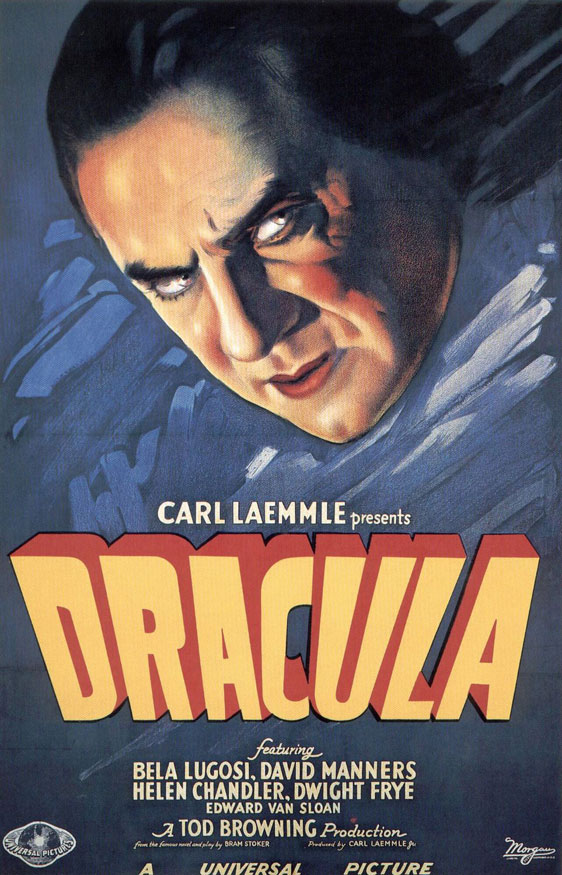
Universal Studios' Dracula

It practically goes without saying that the landscape of cinema history would be radically different had the classic, 1931 version of Dracula never been produced, or been as successful as it was. The film catapulted Bela Lugosi to fame and precipitated Boris Karloff's Frankenstein later that same year, beginning a 30-year legacy of Horror, Thriller and Science Fiction began at Universal Studios. It also cemented the image of the undead lord as a darkly seductive Hungarian in a dinner suit.

Given its seminal status, Dracula provides a clinic in what makes those creaky old Universal films so wonderful. What is it hiding in those shadows on monochrome celluloid that resonates so deeply with viewers, now almost 80 years on? In the North American horror tradition pre-1960, the horror and blood isn't necessarily the point of the horror film. The exploits of Bela Lugosi, Boris Karloff, Lon Chaney Sr. and Jr., and Vincent Price are not merely a parade of "mixed up faces", as Famous Monsters of Filmland publisher Forrest J. Ackerman summed up the mainstream view of horror. Instead, through these films, we but up against the wonder and mysticism of the sublime in all its overwhelming, humbling, astonishing, horrifying glory.


Wednesday, 5 October 2016

The Sublimity of the Universal Studios Monsters

Nothing is so efficacious for horror as the bygone monochrome of the truly silver screen. Only black-and-white held deep enough shadows for monsters to lurk. From within fog-choked forests, immense alpine passes, ancient tombs, and ruined castles, they bid us welcome, show us what it means to trespass in the realms of God, embroil us in the cosmic battle over the human soul, and did it with unparalleled glamour.   

And nobody did it quite as well as Universal Studios. The films of the German Expressionists were beautiful in their artistic, European fashion, and they went on to fuel Universal's own horror pictures. Other films and filmmakers rose to the occasion - White Zombie with Bela Lugosi, Island of Lost Souls with Charles Laughton, Dr. Jekyll and Mr. Hyde with Fredric March, and even the times Mickey Mouse tussled with skeleton dancers and mad doctors - But none matched Universal for sheer output, enjoyment and quality. Hailing from the Silent Era to the Atomic Age, the legacy of the Universal Studios Monsters endures to this day.