.

.
Showing posts with label Cigarette Cards. Show all posts

Wednesday, 3 June 2020

The British Empire According to Players Cigarettes

The following series of 50 cigarette cards produced by the Imperial Tobacco Co. of Great Britain for Players Cigarettes purports to show interesting scenes from across the vast expanse of the British Empire. It is a fascinating glimpse not only into the cultures that made up the empire upon which the sun never set, but also into how British imperialism was celebrated. 

In modern times is difficult to understand, and rightly so, the mindset in which imperialism was considered a source of pride rather than shame. People in the west today often shy away from words denoting any kind of excess of nationalism or patriotism, perceiving them as racist affronts to multicultural values, let alone holding a belief that for their culture to dominate and exploit others was a manifestly good thing. Yet empires from Babylon to Rome to Britain have arguably been history's dominant vehicle of cross-cultural exchange. The movement of goods and peoples across a unified political body exposed the average person in them to a variety of cultures, foods, religions, arts, and ways of life. This is not to excuse or deny the horrors of imperialist regimes, but simply to recognize that empires are complicated entities. 

There is a more interesting question implicit to the sort of exercise in imperialism that these cards represent. It would be easy to dismiss them as artefacts of a disgusting episode in recent human history... It is more challenging to ask of the extent to which modern ideas of multiculturalism are themselves a colonialist, imperialist project.

These cards are from the amazing Digital Collections of the New York Public Library. Click on a card for a larger view.


Wednesday, 7 August 2019

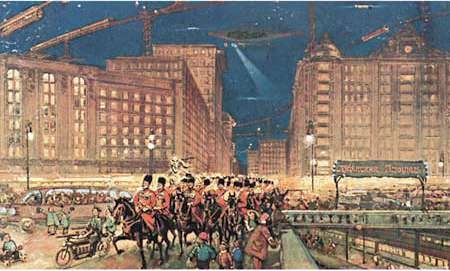
Deutschland im Jahre 2000

In January 1900, the German chocolate company Hildebrands placed these depictions of the Fatherland in the year 2000 in packages of cocoa and chocolates. Like En L'An 2000 and Moscow in the XXIII Century, these cards depict the usual turn of the century ambitions: airships, submarines, covered cities, television, and improved security. The overriding theme is bringing the hitherto unobtainable into the everyday. Aerial travel becomes everyday, and can even be used to venture to impenetrable locales like the Arctic. The oceans become accessible, and what isn't directly accessible is observable through mass media. So, in many ways, we are living in the golden age of Victorian futurism... I just wish it looked as good as these cards.   


Wednesday, 29 May 2019

Chocolat Lombart en l'an 2012

Founded in 1760, Chocolat Lombart was, in its heyday, the oldest and largest company in France. By the 1889 Exposition Universelle, the company was considered a model of efficiency and employee welfare. Their modern factory employed 500 people and provided health insurance, housing, and offered workers a share in the annual profits. All this had to be paid for by chocolate. Like cigarettes, fanciful collectors cards were included in chocolate packages to bolster those sales. In 1912, Chocolat Lombard presented its vision of all the amazing ways that customers could buy Lombart chocolates a century in the future.  

Don't forget the Lombart chocolates!

Stopping off at the chocolaterie.

On the video-phone with their son in Asia.

Chocolate delivery by air.

Le voyages dans la Lune.

Unda' the sea.

Unfortunately, if this advertising worked and you want to enjoy Chocolat Lombart yourself, you're out of luck. The company was absorbed by Menier Chocolates in 1957.  

Wednesday, 23 August 2017

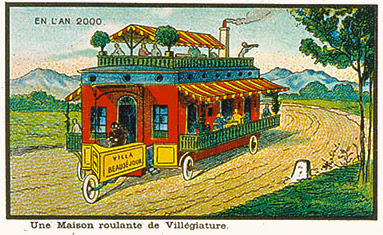
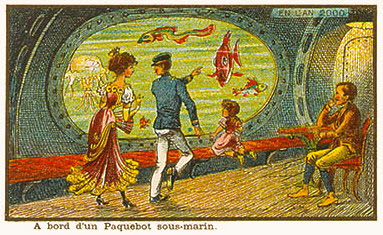
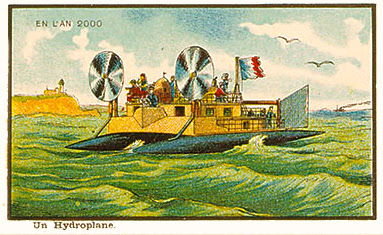
En L'an 2000


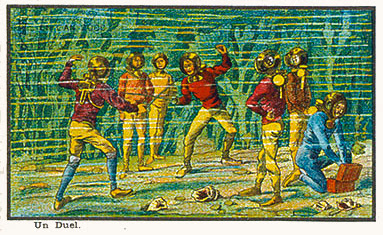
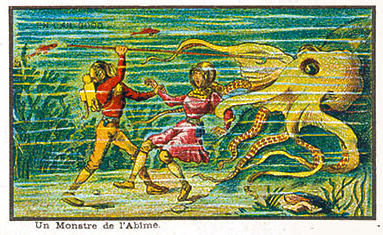
En L'An 2000 (English: In the Year 2000) were a series of cigarette cards produced in France at the turn of 1900. The initial series was released between 1899 and 1901, in conjunction with the 1900 Paris Exposition Universelle, when excitement about the advancements of the coming century were accelerating. A second series was produced in 1910.

For the most part, the series is a fanciful impression of retro-futurism. I don't think many of us have fought off octopi in the last 20 years. There were some astute premeditations of modern technologies that we do take for granted, however, and it is interesting to pick out where the people of the fin de siècle actually did get it right. It's just too bad that we couldn't have kept the elegant fashion they predicted as well!

At least 87 cards were known from the series, produced by a variety of different French artists. Just over half are actually preserved and available for online viewing. Those 55 cards are presented here for your own perusal.